Revenue Isn’t the Problem. It’s What Revenue Is Carrying.
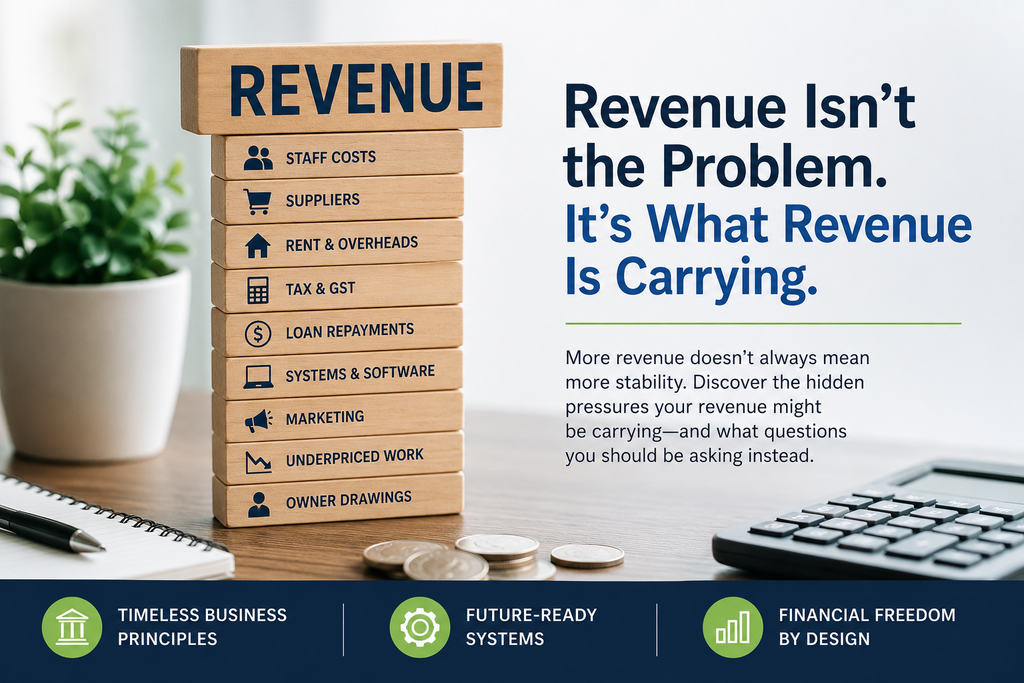
Have you ever found yourself thinking, “If I could just bring in a little more revenue, things would finally feel easier?”
It’s one of the most common beliefs I hear from business owners.
And on the surface, it makes perfect sense. If more money is coming into the business, surely the financial pressure should ease.
But after working with businesses of all sizes, I’ve learned that more revenue doesn’t automatically create more stability.
In fact, sometimes it does the opposite.
The real question isn’t how much revenue your business generates.
It’s what that revenue is carrying.
Revenue Doesn’t Tell the Whole Story
Revenue is often treated as the measure of success.
It’s the number we celebrate.
It’s the number we compare.
It’s the number people proudly share.
But revenue only tells us how much money came in. It doesn’t tell us how much stayed, how efficiently the business operates, or how much pressure that revenue is carrying.
I’ve seen businesses with impressive turnover that still struggle to pay the owner consistently, while smaller businesses with lower revenue enjoy far greater financial confidence.
The difference isn’t always the amount of revenue.
It’s how the business is designed.
Every Dollar Already Has a Job
Imagine every dollar your business earns arriving with a list of obligations attached to it.
- Wages
- Rent
- Suppliers
- GST and tax
- Software subscriptions
- Insurance
- Loan repayments
- Vehicle expenses
Then there are the hidden costs.
- Jobs that were underquoted.
- Clients who demand more time than they pay for.
- Processes that take twice as long as they should.
Before you know it, every dollar has been allocated.
Not because your business isn’t successful, but because your revenue is carrying more than it should.
Growth Can Magnify Existing Problems
Many business owners believe that if they double their revenue, they’ll halve their financial worries.
Unfortunately, growth often magnifies what’s already happening.
If your pricing is too low, more work simply means more underpriced jobs.
If your systems are inefficient, more clients create more complexity.
If you’re not regularly reviewing your numbers, increasing revenue can make it even harder to identify where money is leaking from the business.
Growth is exciting, but without strong foundations, it can become exhausting.
Ask Better Questions
Instead of asking:
“How do I make more revenue?”
Try asking:
- Is my pricing still profitable?
- Which clients contribute the most to my business?
- What costs have quietly increased over the past 12 months?
- Where is my time being spent?
- Are my systems helping the business grow, or making it harder to manage?
These questions shift the focus from chasing more work to building a healthier business.
Financial Clarity Changes Everything
Financial clarity isn’t about obsessing over every dollar.
It’s about understanding how your business really works.
When you know what your revenue is supporting, you can make better decisions about pricing, expenses, growth and investment.
Instead of reacting to financial pressure, you begin planning for sustainable success.
That’s when your business starts working for you, rather than the other way around.
Final Thoughts
Revenue is essential.
Without it, no business survives.
But revenue alone won’t fix underpricing, inefficient systems, unnecessary complexity or poor financial visibility.
Sometimes it simply hides those problems behind a bigger number.
So the next time you find yourself thinking,
“I just need more revenue,”
pause and ask a different question.
What is my revenue carrying?
The answer might change the way you think about your business forever.
Beyond Profit Conversation
Have you ever experienced a time when your revenue increased, but your financial pressure did too?
I’d love to hear your thoughts in the comments.